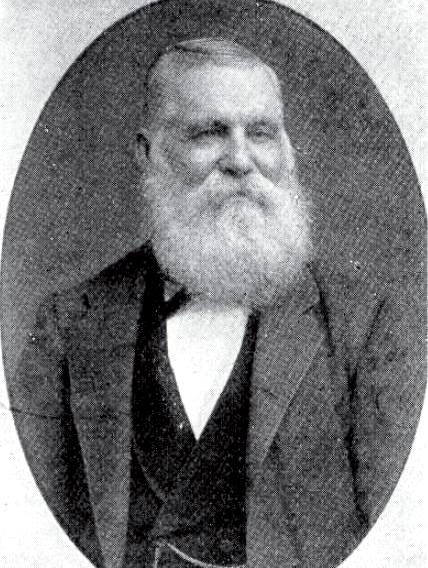
Tuesday, August 29, 2017

Brigham Young-140th anniversary of his death

Brigham Young died on August 29, 1877, 140 years ago today.


I hope that on this day, when we commemorate Brigham Young's death, we take another look at something important he taught just two months before he died because he feared it would be forgotten and lost.

I'm writing this post because if our BYU scholars have their way, this will be forgotten and lost to future generations.
_______________

Brigham Young spent the last year of his life in a remarkable effort to organize and clarify the temple ordinances and to reorganize the Priesthood.

An excellent article titled "The Priesthood Reorganization of 1877: Brigham Young's Last Achievement" starts off by observing this: "Death knocking loudly at his door, President Brigham Young labored restlessly in his last five months of life to reorganize the Church's government structures."

"Brigham's failing health by 1877 made needed priesthood reorderings urgent. That April he confessed, 'I feel many times that I could not live an hour longer.' Knowing the twelve would succeed him, he became very anxious to put the church in excellent order organizationally for them."

In January, Brigham Young was in St. George to work at the temple (which he dedicated four months later on April 6, 1877). On January 9, 1877, baptisms for the dead were performed in a temple for the first time since Nauvoo. On January 11, the first proxy endowments for the dead were performed and children were sealed to couples for the first time. These ordinances had not been performed previously any time in this dispensation.

Often, Brigham was so weak he often had to be carried through the temple.

He commissioned Wilford Woodruff and George Q. Cannon to write down the temple ceremonies for he first time. This was done between April and June 1877.

Next, he reorganized the Priesthood by establishing 7 new stakes. Prior to 1877, there were only 13 stakes in the Church, and six of the Twelve served as Stake Presidents. The Salt Lake Stake presidency and high council presided over other stakes and had 20,000 members with 45 wards. There were Stake Presidents and Bishops who didn't have counselors, wards without Bishops, and the Priesthood quorums were disorganized.

In 1877, new stake presidencies were called; of sixty presidency members, 53 were new. 140 new wards were established, 100 new Bishops called, and 85 acting bishops were made Bishops.

The article explains: "the 1877 reordering was the single most important priesthood analysis and redirecting since the priesthood restorations of forty eight years earlier."
________________________

In addition to organizing the Temple and Priesthood, Brigham Young taught essential principles that remain relevant today. In his final sermon on August 19, 1877, he focused on the Sacrament, just as our current leaders have been doing.

"Previous to attending to the business to be presented to the congregation this afternoon, I feel to exhort the Latter-day Saints before me to try to realize the sacredness of the ordinance that is now being administered to them, which was introduced by our Savior, that his disciples might witness to the Father that they were truly his followers."

In June, he told the Saints something that he was concerned would be lost and forgotten after he died. "I relate this to you, and I want you to understand it. I take this liberty of referring to those things so that they will not be forgotten and lost."

What was this important topic?

It had to do with the Hill Cumorah.
________________

Just two months before he died, in the midst of reorganizing the Priesthood and setting in order the Temple ordinances, Brigham Young felt compelled to emphasize the reality of the Hill Cumorah by explaining that Joseph and Oliver and others actually entered Mormon's depository. Starting on page 38, here, he said:

"I lived right in the country where the plates were found from which the Book of Mormon was translated, and I know a great many things pertaining to that country. I believe I will take the liberty to tell you of another circumstance that will be as marvelous as anything can be. This is an incident in the life of Oliver Cowdery, but he did not take the liberty of telling such things in meeting as I take. I tell these things to you, and I have a motive for doing so. I want to carry them to the ears of my brethren and sisters, and to the children also, that they may grow to an understanding of some things that seem to be entirely hidden from the human family.

Oliver Cowdery went with the Prophet Joseph when he deposited these plates. Joseph did not translate all of the plates; there was a portion of them sealed, which you can learn from the Book of Doctrine and Covenants. When Joseph got the plates, the angel instructed him to carry them back to the hill Cumorah, which he did. Oliver says that when Joseph and Oliver went there, the hill opened, and they walked into a cave, in which there was a large and spacious room. He says he did not think, at the time, whether they had the light of the sun or artificial light; but that it was just as light as day. They laid the plates on a table; it was a large table that stood in the room. Under this table there was a pile of plates as much as two feet high, and there were altogether in this room more plates than probably many wagon loads; they were piled up in the corners and along the walls. The first time they went there the sword of Laban hung upon the wall; but when they went again it had been taken down and laid upon the table across the gold plates; it was unsheathed, and on it was written these words: “This sword will never be sheathed again until the kingdoms of this world become the kingdom of our God and his Christ.”

I tell you this as coming not only from Oliver Cowdery, but others who were familiar with it, and who understood it just as well as we understand coming to this meeting, enjoying the day, and by and by we separate and go away, forgetting most of what is said, but remembering some things. So is it with other circumstances in life. I relate this to you, and I want you to understand it. I take this liberty of referring to those things so that they will not be forgotten and lost. Carlos Smith was a young man of as much veracity as any young man we had, and he was a witness to these things. Samuel Smith saw some things, Hyrum saw a good many things, but Joseph was the leader.

Now, you may think I am unwise in publicly telling these things, thinking perhaps I should preserve them in my own breast; but such is not my mind. I would like the people called Latter-day Saints to understand some little things with regard to the workings and dealings of the Lord with his people here upon the earth."
___________________

Brigham Young emphasized how important it was to understand Cumorah. He prefaced his remarks by explaining these events took place right there in New York, where he lived.

But because of Mesomania, many LDS scholars and educators claim this was merely a "vision" of a hill in Mexico.

You may think I'm kidding, and I wish I was, but look at what FairMormon says about this:
 https://www.fairmormon.org/answers/Question:_Is_there_a_cave_in_the_Hill_Cumorah_containing_the_Nephite_records%3F.

My favorite part of FairMormon's answer is this. "If, therefore, the story attributed to Oliver Cowdery (by others) is true, then the visits to the cave perhaps represent visions, perhaps of some far distant hill, not physical events."

FairMormon and the Conclave generally excel in casting doubt on the Three Witnesses and their contemporaries, including Joseph Smith. You can see how readily and easily they say "If this story is true..." Then, after Brigham Young introduced this account by explaining how he lived in this area of New York, FairMormon says Brigham was either lying or telling about a vision of a hill in Mexico.

Now you see why I deplore FairMormon's Mesomania and why I hope people don't go to this site for answers about Cumorah, Book of Mormon geography, and Church history.

Obviously, if Mormon's depository was in the New York hill, the entire premise for the Mesoamerican and two-Cumorahs theories is false.

Our Mesomania scholars desperately try to explain away what Brigham Young said shortly before he died. They try to explain away what David Whitmer said. They try to explain away what Oliver and Joseph wrote in Letter VII.

As I wrote at the outset, I hope that on this day, when we commemorate Brigham Young's death, we take another look at what he feared would be forgotten and lost.

Because if our BYU scholars have their way, it will be forgotten and lost to future generations.
_________________

Brigham Young's final sermons:

June 17, 1877 - Discourse by President Brigham Young, delivered at a Special Conference Held at Farmington, for the Purpose of Organizing a Stake of Zion for the County of Davis, on Sunday Afternoon, June 17, 1877
Trying to Be Saints—Treasures of the Everlasting Hills—The Hill Cumorah—Obedience to True Principle the Key to Knowledge—All Enjoyment Comes From God—Organization—Duties of Officers—Final Results

July 19, 1877 - Discourse by President Brigham Young, delivered in the Tabernacle, Ogden, at a Meeting of the Relief Societies of Weber County, July 19, 1877.
Relief Societies—Talk to Mothers—Improvement Societies—Domestic Matters—Training Children—Home Production—Silk Interests

July 24, 1877 - Address by President Brigham Young, delivered to the Sunday School Children, in the New Tabernacle, Salt Lake City
Items of History—The Pioneers—Talking to the Children—Peace in Utah—God a Personage of Tabernacle—The Foolish Fashions

August 19, 1877 - Discourse by President Brigham Young, delivered at a Special Conference Held in Brigham City, Box Elder County, for the Purpose of Organizing a Stake of Zion in Said County, on Sunday Afternoon, August 19, 1877.
The Lord's Supper—a Word to Mothers—The Sacrament in Sabbath Schools—History of Some Things—Young Men to Preside—Home Manufactures

August 29, 1877 - Died in Salt Lake City

Thursday, July 27, 2017

Why mesoamerican advocates align with anti-Mormons about Cumorah


Why BYU/LDS Mesoamerican advocates align with anti-Mormons about Cumorah

As I've pointed out before, BYU Studies, FairMormon and the rest continue to promote the Mesoamerican and two-Cumorahs theories. Right on their splash page, they have a link to "Charting the Book of Mormon," a document that strongly promotes Mesomania.

Look at their page on "Plausible Locations of the Final Battles" here.

https://byustudies.byu.edu/charts/13-159-plausible-locations-final-battles

They show a map of Mesoamerica and then explain it this way:

The hill Ramah/Cumorah, upon which both the Jaredites and Nephites fought their last battles (see Ether 15:11; Mormon 6:4–6), is shown here on the northwestern edge of the Tuxtla Mountains in Mexico, about ninety miles from a narrow pass (see Mormon 3:5). Other Jaredite locations, including Omer's flight to Ramah (see Ether 9:3), are also shown here. Again, these locations are plausible, but not definite.
_________________

What is not included on their list of "plausible locations of the final battles" is the place where Joseph and Oliver said it actually took place; i.e., the hill Cumorah in New York.

This is one of many examples of how BYU Studies continues to teach that Joseph and Oliver were ignorant speculators who misled the Church about the Hill Cumorah.
_________________

This Mesomania has significant implications. BYU Studies offers a comparison of "The Two Final Battles" involving the Jaredites and the Nephites, here: https://byustudies.byu.edu/charts/11-138-two-final-battles


Notice the row titled "how many." They want people to believe that 2 million Jaredites were killed at Cumorah and "around" 230,000 Nephites.

This is the same theory that FairMormon wants people to accept. Here, for example, FairMormon claims the Hill Cumorah must be "large enough to view hundreds of thousands of bodies."

These are exactly the same claims made by anti-Mormons to undermine faith in the Book of Mormon. 

And Oliver Cowdery addressed these false claims way back in 1835.

___________________

Oliver explained that Mormon foresaw the approaching destruction and its parallel to the Jaredite destruction in the same place. Speaking from Mormon's perspective, and after describing the mile-wide valley west of the Hill Cumorah, Oliver wrote:

"In this vale lie commingled, in one mass of ruin the ashes of thousands, and in this vale was destined to consume the fair forms and vigerous systems of tens of thousands of the human race—blood mixed with blood, flesh with flesh, bones with bones and dust with dust!"

Oliver described the remains of the Jaredites as "the ashes of thousands." Not millions, but thousands. Not even tens of thousands. Just thousands.

When we read the Book of Mormon carefully, we recognize that Oliver was correct. The 8-day Jaredite battle at Cumorah could not have involved more than a few thousand, as we see from the count of the actual number killed on the last two days. Coriantumr realized that two million of his people had been killed long before they reached Ramah, or Cumorah. (Ether 13) There were additional battles leading up to Cumorah. Even after four years, they could gather only a relatively few people to Cumorah, so few that after six days of battle, there were only 121 people left. The next day, there were only 59 left. Even if we assume that half the people were killed each day, that calculates to about 7,744 on the first day of battle.

Hence, Oliver wrote that there were the "ashes of thousands," not even tens of thousands.

Same with the Nephites.

Oliver says "tens of thousands" were to be killed, including Lamanites and Nephites. 

Mormon said he could see 20,000 from the top of Cumorah. (Mormon 6:11-12). The rest of his people, the ones Mormon lists in verses 13-15, had died long before the final battle at Cumorah. Mormon and Moroni could not see those dead people from Cumorah. Let's say an equivalent number of Lamanites were killed. That totals 40,000. This fits the "tens of thousands" Oliver mentioned.

You can read this right out of Joseph Smith's own history, titled History, 1834-1836, which is found in the Joseph Smith Papers here: http://www.josephsmithpapers.org/paper-summary/history-1834-1836/83. The portion I quoted is from this page: http://www.josephsmithpapers.org/paper-summary/history-1834-1836/92

_______________

There are two important keys here.

First key: Mesoamerican advocates and anti-Mormons make the same claims, albeit for different reasons.

Estimates based on the text and what Oliver and Joseph said:

Jaredites: under 10,000
Nephites and Lamanites: tens of thousands.

Estimates based on the claims of Mesoamerican advocates and anti-Mormons:

Jaredites: 2 million
Nephites and Lamanites: hundreds of thousands.

The anti-Mormons like the large numbers because there are no known locations anywhere in the Western Hemisphere where there is evidence of hundreds of thousands of people being killed at a single site, let alone 2 million.

The Mesoamerican advocates like the large numbers because they think this excludes the New York hill as a "plausible" candidate for Cumorah, which is one of the foundations of their "two-Cumorahs" theory. They think Cumorah must be a huge volcanic mountain somewhere in Mexico, large enough to accommodate these large numbers of people.

Second key: what evidence should we expect to find at Cumorah? 

Our assumptions make a big difference. The smaller numbers would lead us to conclude that the New York hill fits just fine; i.e., we don't need a massive mountain somewhere upon which 2 million people could fight and die. We don't even need a place where hundreds of thousands of people could fight and die. And we wouldn't expect to find evidence of such mass destruction.

What we do have in western New York is a series of small forts and defensive positions, mass graves containing hundreds, but not thousands, of bodies, and in the vicinity of the hill Cumorah itself, decades of farmers plowing up arrowheads, ax heads, and similar stone weapons which they gave away or sold to tourists. Just a few years ago a Jaredite era arrowhead was found on top of the Hill Cumorah, not far from the parking area. All of this is consistent with the tens of thousands of people killed, but not the hundreds of thousands claimed by anti-Mormons and Mesoamerican two-Cumorahs advocates.

By comparison, consider the famous Battle of Hastings, which was relatively recent (1066). The battle changed the course of British history. 10,000 men were said to have died there, in a specific spot of England that was well documented and known ever since. They found one skeleton that might be related to the battle, as explained here. The article says, "No bones have previously been discovered of anyone who fought and died during the historic event.... The Norman invaders were thought to have buried their dead in a mass grave. Although no grave pits of the Normans have been found, it is believed that this is due to the high acidity of the soil, which means all the remains have long deteriorated."

There are ongoing debates about even the location of the battle. E.g., here and here.

Friday, May 20, 2016

More on David Whitmer, Zina Young, and Cumorah


David Whitmer, circa 1855
(photo links to JSP)
This post offers more detail on David Whitmer and Zina Young.

I've had some feedback on the previous post that there is no evidence Zina had heard about David Whitmer's Cumorah experience from David himself. It's true we don't have written evidence of when she heard the story or from whom, but Stevenson's journal shows Zina had heard it from somewhere before Stevenson visited Whitmer. That's why she told Stevenson to ask Whitmer about it. I imagine the conversation being something such as this:

Zina: "You're going to visit David Whitmer?"
Stevenson: "I plan to. I hope he'll see me."
Zina: "Ask him about the Nephite he met."
Stevenson: "He met a Nephite?"
Zina (nodding): "And he was carrying the plates to the hill Cumorah because Joseph didn't want the responsibility. David, Joseph and Oliver Cowdery were riding in a wagon from Harmony to the Whitmer farm. He'll tell you all about it."
Stevenson: "Sounds interesting."
Zina: "You should publish it when you get back."

The Mesoamerican advocates who reject Whitmer's testimony rely on the "late" retelling to Stevenson and Joseph F. Smith. Their objection is based on the premise that Whitmer's experience hearing the term "Cumorah" for the first time occurred in 1829, but he did not tell the story before 1878. Certainly, 50 years after the fact could be considered late; each person has to assess that "lateness" in light of the detail of Whitmer's account, the surprising and unusual circumstances, and the presence of Joseph and Oliver when the event occurred.

The Stevenson account undermines the "lateness" objection, however. Whether Zina heard the story directly from Whitmer in 1835, or heard it from someone else, the point is that she did hear it before Stevenson asked Whitmer about it. From his journal, we have to infer that Stevenson had not heard the story before.

There is no record of anyone knowing this story before Stevenson's interview with David, except for Zina. So all the evidence we have suggests that before the interview, the only two people who knew the story were Zina and David (and Oliver and Joseph, if David's testimony is to be believed, but Joseph and Oliver were dead by then).

And the only evidence we have of David and Zina interacting was when David and Hyrum Smith were missionary companions in 1835 in Watertown, NY, where Hyrum baptized her. [This is no minor point. David Whitmer didn't go on a lot of missionary journeys. When you read Zina's account, notice how she emphasizes how hard David worked to persuade her to get baptized. I think it's safe to infer he tried everything he could, including his viewing of the golden plates as one of the Three Witnesses. In this context, his claim he saw one of the Nephites carrying the plates to Cumorah would be another thing to bring up.

Later, Joseph F. Smith and Orson Pratt visited David Whitmer and elicited the same story from him. This suggests they first heard it when Stevenson published it (or told them about it).

Zina published an article, probably taken from parts of her journal we don't otherwise have now, in the April 1893 issue of The Young Woman's Journal. Titled "How I Gained my Testimony of the Truth," the article gives details on how she joined the Church in 1835. It is available online here. In the next section, I show the relevant aspects of Zina's article.
___________________

In the following summer Hyrum Smith and David Whitmer came to our house and stayed several days. Father and mother had been baptized in the April of that same year, but neither myself nor my sister were baptized.

David Whitmer persuaded me to be baptized while they were at our home, but some way I did not accept his offer. I had told my sister-in-law, Fanny Huntingdon, that when she was baptized I would go with her.

The morning for the departure of these men from our house arrived, and I had not as yet become a member of the Church. That morning, a short time before they were to start, Hyrum Smith’s cousin rode up with a message that they could not leave that day, as my brother Dimick and his wife Fanny, my dear sister-in-law, were desirous of being baptized.

That morning at prayers I had presented to me a heavenly vision of a man going down into the water and baptizing someone. So when this message came I felt it was a testimony that the time had come for me to receive baptism. Brother Hyrum Smith was mouth in prayer, and in my secret soul I had a wish that he should baptize me. I had refused the coaxing of Brother Whitmer, as I told myself, because mother and father were going away from home, and I had all the home cares on me, and I feared I would be tempted to speak crossly or say something I ought not to after so sacred an ordinance as that; but this strong testimony that the proper time had arrived I did not dare treat lightly.

As soon as I consented to go with my brother and sister-in-law David Whitmer began talking about performing the office for us. Happily for me, however, Brother Hyrum was chosen by the others to be the proper one and I added my preference to their words. Accordingly, we all went down to the water and were baptized by Hyrum Smith, and confirmed under the hands of Hyrum Smith and David Whitmer. [This was on August 1, 1835.]

Wednesday, May 18, 2016

Note on Cumorah, David Whitmer and Zina Young

I realize the topic of Cumorah has been discussed a lot lately, so don't read this if you're tired of the Cumorah topic. I actually covered this topic in detail last August, 

here. I'm writing today because of a new bit of information that's always been available but I didn't really notice until now and I wanted it here on the blog as a note for future reference.

If you're new to this topic, it has to do with two of the Three Witnesses. Those who advocate a Mesoamerican geography reject Oliver Cowdery's description of Cumorah in Letter VII. They also reject David Whitmer's explanation of the first time he heard the word Cumorah (which he said was in June 1829, before he'd ever read the text, and he heard it from a heavenly messenger).

The rationale for rejecting David Whitmer's testimony is that he supposedly never talked about it until 50 years after the fact, in interviews he gave to Edward Stevenson in 1877 and to Joseph F. Smith and Orson Pratt in 1878.

Here's how one scholar articulated the argument (I won't mention names, but you can get it from my August post if you're interested):

Edward Stevenson
"The earliest possible connection between the New York hill and the Book of Mormon Cumorah comes from an 1878 interview with David Whitmer by Orson Pratt and Joseph F. Smith,... This report [the Whitmer interview] would be much more conclusive had it not been recorded nearly fifty years later. The passage of time and the accepted designation of “Cumorah” as the name of the New York hill by the time of the recollection argue against the second-hand report from Whitmer as being a definitive statement."

There are all kinds of logical errors in that statement, but I've addressed those before. Today, I want to point out something in the Stevenson statement, taken from his contemporaneous journal.

I obtained a copy of Stevenson's journal recently and here's what his entry says:

Page from Stevenson journal
"I wish to mention an Item of conversation with David Whitmer in regard to Seeing one of the Nephites, Zina Young, Desired me to ask about it. David Said, Oliver, & The Prophet, & I were riding in a wagon, & an aged man about 5 feet 10, heavey Set & on his back, an old fashioned Armey knapsack Straped over his Shoulders & Something Square in it, & he walked alongside of the Wagon & Wiped the Sweat off his face, Smileing very Pleasant David asked him to ride and he replied I am going across to the hill Cumorah. Soon after they Passed they felt Strangeley and Stoped, but could see nothing of him all around was clean and they asked the Lord about it. He Said that the Prophet Looked as White as a Sheet & Said that it was one of the Nephites & that he had the plates."*

________________________________

Edward Stevenson was a general authority (one of the seven presidents of the Seventy). He was a well-known missionary (one of the MTC buildings is named after him). There's no reason to doubt the credibility of his interview with David Whitmer.

What I find fascinating is that Zina Young asked Stevenson to ask David Whitmer about seeing one of the Nephites. That was the focus of the interview, not the Cumorah question.

Zina Young
This means that Zina had heard this story earlier. 

Why Zina Young? 

And when could she have heard it? 

And from whom?

It could not have been from the interview with Joseph F. Smith, which occurred a year later.

Instead, it's highly likely she heard it from David Whitmer directly!

Zina was born in 1821. Her family lived in Watertown, New York. In 1835, when she was 14 years old, two missionaries came to town: Hyrum Smith and David Whitmer. Hyrum baptized her on August 1, 1835. The family moved to Kirtland, and eventually to Far West, and then to Nauvoo along with most of the rest of the Saints. Zina married, had two children, and then also married Joseph Smith. After his death, she married Brigham Young. (That's a topic for another day.)

David Whitmer left the Church in 1837-1838 and lived in Missouri for the rest of his life. Zina would have had no contact with him after about 1837, at the latest. If that's the case, then she could only have heard the story from him between 1835 and 1837--just a few years after 1829, when David said the event happened.

Of course, modern Mesoamerican scholars will dispute this somehow, but the argument that David's testimony is unreliable because it was 50 years late contradicts the Stevenson account.

Interestingly, Zina was also the one who inherited Joseph's seer stone after Brigham Young died.

The simplest, historically justified explanation is that David told Zina and her family the story when he contacted them as a missionary. Zina remembered it and told Stevenson to ask David about it in 1877. Stevenson recorded it and wrote about it. 

David Whitmer
Then Joseph F. Smith asked David about it, and he reiterated his account of the event.

It's not a 50-year-old story related from a feeble and tainted memory. It's a retelling of an account related by a missionary to his investigators just a few years after the event.

Other than to defend the Mesoamerican ideology, there's no reason to cast doubt on the testimony of the Three Witnesses.
________________

The bottom line is this (adapted from my August post):

Think about this. To accept the Mesoaemerican setting you have to disbelieve two of the three main witnesses to the Book of Mormon: Oliver Cowdery and David Whitmer. The Mesoamerican advocates seek to persuade you these two men were not reliable witnesses when it comes to the issue of Cumorah being in New York.

By contrast, to accept the North American (or Heartland) setting, you fully embrace what these two men said.
________________

References: http://contentdm.lib.byu.edu/cdm/ref/collection/BYUIBooks/id/3527

*You can find this account in these references, although apparently not transcribed exactly: "Edward Stevenson Interview (1) 22-23 December 1877, Richmond, Missouri Diary of Edward Stevenson," LDS Church Archives, Lyndon W. Cook, ed., David Whitmer Interviews, 1993, p. 13; also Dan Vogel, ed., Early Mormon Documents, 2003, vol. v, p. 30.

Tuesday, May 10, 2016

Abstract maps revisited


Abstract maps revisited


I've commented on the futility of abstract maps before, but a new one has appeared that prompts me to revisit the topic.

I actually like this one a lot. It is well executed, with good coloring and detail. I'm not criticizing the people who put this map together, and I'm not criticizing those who published it, because I think they are well-intentioned and I like the map because it is at least ambiguous (i.e., there is no actual place on Earth that looks like this).

Plus, they cited Moroni's America in the footnotes.

:)

However, I think it's a mistake to create an abstract map of the Book of Mormon in the first place, because the process requires a series of assumptions not required by the text, and the mere creation of the map transforms a theory into an artificial reality. Images such as this create their own reality in the mind of the viewer, and it becomes difficult to dislodge the image while reading the text. For example, this abstract map essentially codifies an interpretation of "narrow neck of land" that I think is inconsistent with--or at least not required by--the text.

(I'm not going to point out areas in which I think this map contradicts the text because that's the inherent problem with abstract maps--they are all entirely subjective. No two people, working independently from the text alone, can possibly create the same abstract map--unless they share a mental image they've previously seen or been taught.)

(I also don't think there is a problem with most of the generic relational maps found in current Church lesson manuals; i.e., Zarahemla is north of the land of Nephi. This helps students follow the text without imprinting an arbitrary abstract map on their minds.)

I think it would be far more productive to develop a Book of Mormon map based on a real-world setting we already know about, which I discuss below.
________________

If we're going to depict abstract maps, we should at least show some alternatives. In this case, we have some variation, but not a single map shows Cumorah in New York! A person reading this post would have no idea that a New York Cumorah is even an option (let alone that it was universally accepted as long as Joseph Smith was alive).

In fact, the caption notes that all the maps "exhibit general consistency." I see that as a defect, not a feature.

If the point is that the geography passages in the text are internally consistent, which the narrative here suggests, that's a valid point. But the collage of maps shows a consistency in interpretation, which is precisely the problem with creating abstract maps in the first place. They create a mental image that leads to derivative maps such as these, but not to new or different interpretations.
__________________

One example I've used before is from Xenophon's Anabasis. This is a Greek text that I studied when I was learning Greek many years ago. There's a good introduction to Xenophon here. As a member of a greek army, he wrote a narrative of the Persian Expedition (Anabasis means expedition) in 401 B.C. Like Mormon, he mentioned distances and directions but did not include a map in his narrative. Unlike the Book of Mormon, though, the Anabasis took place in a well-documented area of the world. Consequently, scholars have been able to map the expedition.

Or have they?

Even with all the touchstones--the pins in the map--that Xenophon gave us in his narrative, all well-known in terms of history and geography, scholars continue to debate about particular details of the expedition. For example, here's an article that assesses the ongoing debate about routes and parasangs in the the Anabasis. Look at Map 2 on p. 226. There are four different proposals for the retreat, based on different scholarly interpretations of the river Xenophon was referring to.

Now, imagine how confused Xenophon scholars would be if they had not a single pin in the map. That's what we have when Book of Mormon scholars disregard the New York Hill Cumorah.
_________________

Another example is Lewis and Clark. Thomas Jefferson sent them to explore the "Continent of North American" as Clark phrased it on his 1810 map. Before he left, Jefferson personally taught Lewis how to determine latitude using an octant. Lewis and Clark took rudimentary maps with them.

The Lewis and Clark journals are almost 5,000 pages long. Did Thomas Jefferson create an abstract map based on their narrative?

Of course not.

Lewis and Clark (well, Clark) created 140 maps! Plus, they collected 30 maps from people they encountered, including Indians and traders.

When they got home, Clark spent years compiling a comprehensive map (the 1810 map). He relied on his personal knowledge, the 170 maps they accumulated, and interviews with Indians and traders. It was a remarkable accomplishment, but if you compare it to a google Earth map, you'll immediately see the errors.

It was an effective map for people operating on the ground, following rivers and landmarks, but it was not "accurate" in the sense we're used to today.

Now, if someone were to take the 5,000 pages of journals and try to create an abstract map, would they come up with something close to Clark's map? Probably. Why?

Because everyone already has a mental image of what North America looks like.

Take someone who has never seen a map of North America, maybe someone from Mongolia or the Amazon basin, and have them create an abstract map of North America from the Lewis and Clark journals. What are the chances they'll produce a map we would recognize?

Essentially zero.

Yet that's what Book of Mormon scholars are trying to do when they reject the New York setting for the Hill Cumorah.

That's why I think the effort is futile. Worse, it is counterproductive.
_______________

What would make more sense, IMO, would be a serious, multi-disciplinary effort to analyze the text using the New York Cumorah as a starting point--as a pin in the map. Throw out the mental images of the "narrow neck of land" in Central America--after all, that feature is found in exactly one verse in the entire text, Ether 10:20--and see what we come up with.

[Because the image of the Central American narrow neck has been imprinted on the minds of nearly every Latter-day Saint by now, it may require non-LDS people to do this experiment. Unfortunately, most non-LDS who have heard anything about the Book of Mormon have also had this image imprinted, so we'd probably have to find people who have never heard of Mormons before.]

People who object to the New York Cumorah can at least accept this challenge as a testable hypothesis.

It would be interesting to see how many variations people would develop, even when they have a solid starting point in New York.

We would always have differences of interpretation about details, as in the case of the Anabasis, but at least we might have an overall map that works in the real world and incorporates all of the geography "clues" in the text.

Even better, we could add the second pin--Zarahemla in Iowa.

I think we'd end up with something such as this:


You fill in the blanks for Cumorah, Bountiful, etc.

:)

Monday, May 9, 2016

The futility of an abstract map


The futility of an abstract map

This week I did a presentation for a private group of about 60 people. Among other things, I explained the futility of trying to develop an abstract map based on the text of the Book of Mormon.

No two people can possibly come up with the same map, simply because the text is too vague.

Think of a group of five Boy Scouts. You give them a set of instructions for a rendezvous point and have them leave about 30 minutes apart. Here are the instructions:

"Journey in the wilderness for the space of many days."

Are they going to end up in the same place? Of course not. So you give them something more specific: "Travel eight days’ journey into the wilderness."

They could go in any direction, and just about any distance.

How about this? "Go three days’ journey on the north of the land of Melek." Even if they knew where Melek was, they won't end up in the same place.

Of course, these are all quotations from the text.

Now, a particular group of people can reach a consensus about an abstract map by reaching agreement on how far someone will travel in a day, and in what direction, but it's at best a guess. Usually it's completely arbitrary and creates at best an illusion of accuracy based on a series of assumptions.

And yet, this pursuit of an illusory abstract map has dominated the discussion among Book of Mormon scholars for decades.
__________________

The only way to develop even a plausible map based on an ancient text is to have at least one identifiable point. There has to be at least one connection between the text and the modern world. (Even with that, there will be some uncertainty. Despite thousands of years of history, there are still differences of opinion regarding the location of Mount Sinai, for example.)

I describe this as a pin in the map. With one known site, we at least have a frame of reference for the rest of the geography.

For the first 100 years of Church history, we had that one pin: the Hill Cumorah in New York. It was unequivocally accepted that the New York hill was the scene of the last battles of the Nephites and Jaredites.

But then things changed, and that's a topic of another post.
___________________

An amazing amount of time and effort has been wasted on abstract maps because so many people have refused to accept the pin of Cumorah in New York. That's all water under the bridge, of course; I just hope we can avoid more wasted time and effort going forward.